
Surviving the PV Growth Trap: A Blueprint for Overwhelmed Safety Leaders
Executive Summary
Rapid expansion through acquisition or market entry is a significant risk factor for pharmacovigilance (PV) systems in small and medium-sized enterprises. Structures built for steady-state operations often fracture under sudden pressure, leaving leadership in a reactive crisis mode. To maintain compliance and operational resilience, Heads of Safety must change their approach to scaling.
The Iron Triangle: Why Money Alone Fails
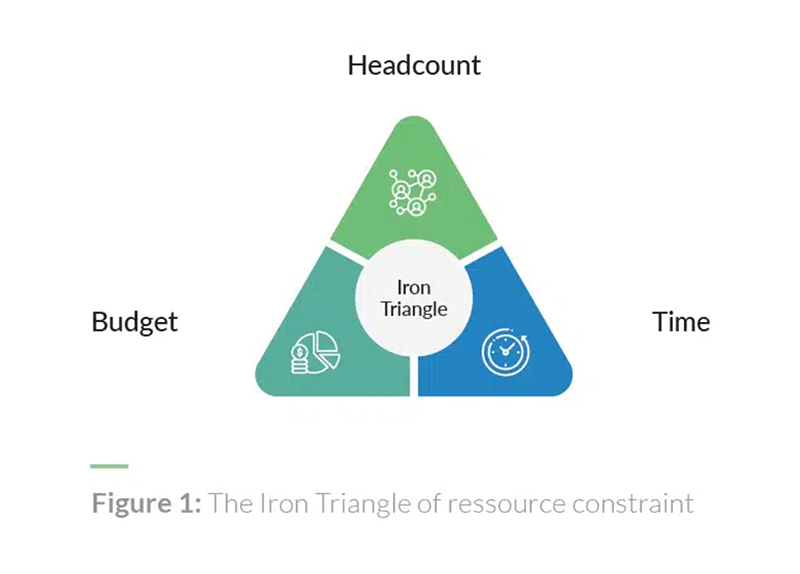
When an acquisition occurs, the volume of Individual Case Safety Reports (ICSRs) can increase significantly overnight. Many leaders attempt to solve this with a new budget, but the “Iron Triangle” of resource constraints—headcount, budget, and time—is unforgiving. Money cannot buy time.
Recruiting and training qualified PV personnel takes months, while regulatory integration windows often close in weeks. This mismatch forces organizations to rely on existing staff to manage the transition, which leads to burnout, quality deviations, and potential compliance failures.
Getting Your Head Above the Water Line
The leadership burden typically falls on the Head of Safety, who often also serves as the EU-QPPV. While trained as safety scientists or physicians, these individuals are suddenly cast as change leads and project managers. They must navigate data migration, vendor selection, and organizational restructuring—all while ensuring that the core mission of patient safety remains uncompromised.
To survive, the Head of Safety must evolve from a Safety Scientist to an Ecosystem Architect. This shift requires moving away from manual oversight toward orchestration. By establishing a unified corporate strategy that prioritizes the PV ecosystem, leaders can align internal silos like IT, Legal, and Quality to ensure system agility.
Smart Sourcing: Protecting the Core
Sustainable scaling requires a clear distinction between core work and surge requirements. A “Smart Sourcing Strategy” identifies specific competencies that must remain under in-house strategic oversight.
- Keep In-House: Strategic oversight and risk management should remain internal to ensure full ownership of safety data and logic.
- Outsource: Volume-heavy tasks and supportive functions, such as literature screening and case processing surges, can be delegated to partners to absorb the surge.
By delegating these tasks, the core team retains the capacity for strategic decision-making and maintains the long-term integrity of the PV system.
Build Your Integration Playbook
The pressure of growth does not have to result in organizational crisis. Moving from reactive management to a strategic, vendor-neutral playbook ensures that expansion strengthens your organization rather than compromising it.
As your organization prepares for its next milestone, having the right roadmap is essential. VIGINEXT specializes in guiding pharmaceutical companies through these critical transitions with expert-led, vendor-neutral consulting.



Reach Out Today

United Kingdom
3a Rosemary House, Lanwades Business Park,
Kennett, Newmarket, CB8 7PN
Germany
Mafinex Technology Center
Julius-Hatry-Str. 1
68163 Mannheim